
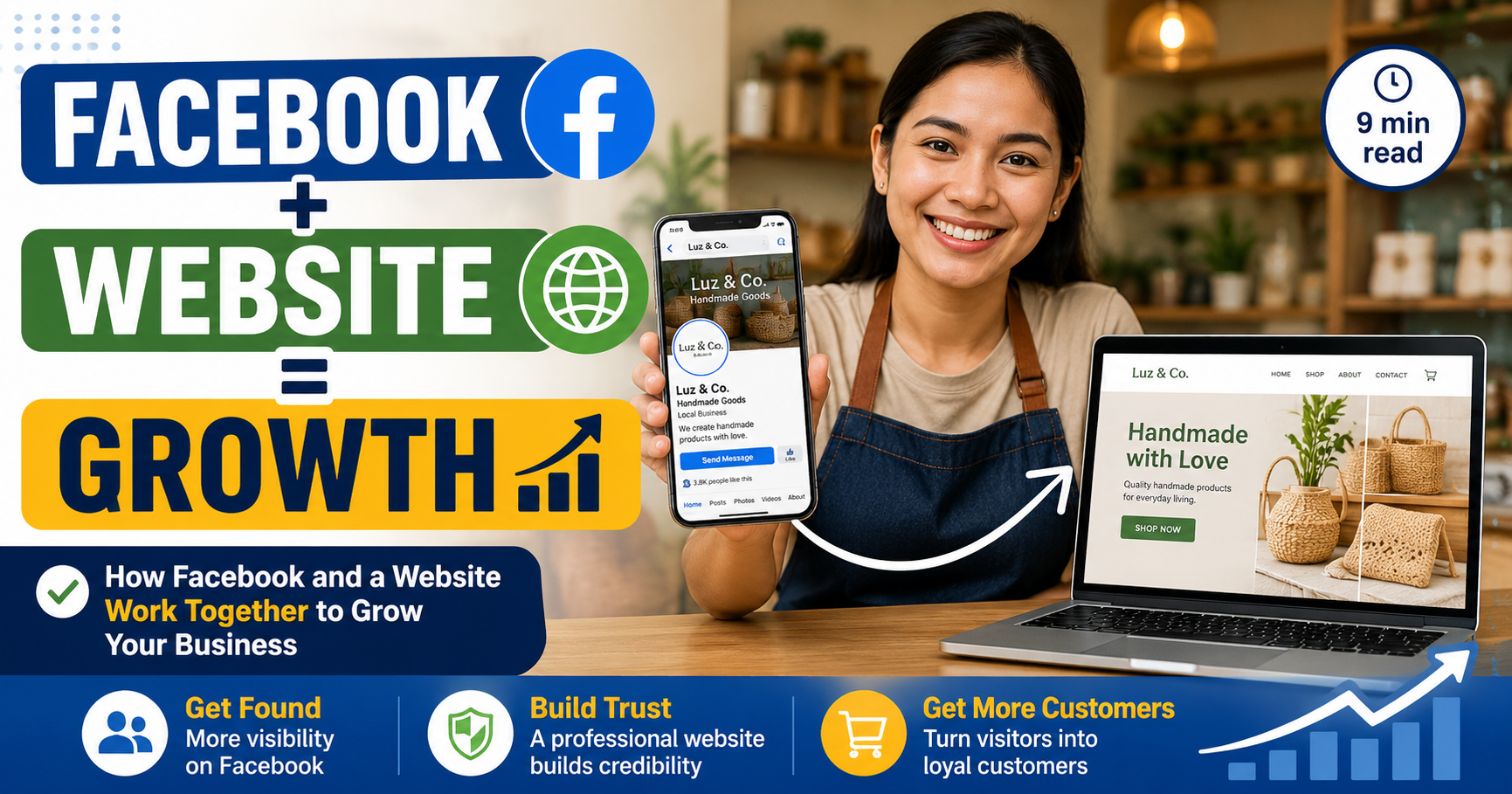
How Facebook and a Website Work Together to Grow Your Business
In this article, you'll learn:
- Why Facebook and a website have different roles
- How they work together to grow your business
- Simple ways to connect both platforms for better results
If your business already has a Facebook Page, you are doing something right. Facebook is where millions of Filipinos discover new products, follow their favorite local shops, and message a business the moment they are curious about something. It is fast, familiar, and genuinely effective at getting your business seen.
The question this article explores is not whether Facebook works. It clearly does. The question is what happens after someone finds you on Facebook and wants to learn more before they buy. That is where a website quietly takes over, and where the two platforms, used together, become far more powerful than either one alone.
Many small business owners in the Philippines assume they have to choose between Facebook and a website, as if picking one means giving up the other. In practice, the most successful local businesses do not treat it as a choice at all. They let Facebook do what it does best and let their website do what it does best, and the two support each other every day.
This is especially true for home-based sellers, freelancers, and startups, where every peso and every hour matters. You do not need to abandon the Facebook Page you have already built a following on. You simply need to give that following somewhere to go once they are ready for more than a comment or a like, and closing that gap is often what helps a small side hustle grow into something bigger.
Table of contents
Why Facebook Is Great for Small Businesses
Facebook earned its place at the center of Filipino small business marketing for good reason. It is one of the fastest, most affordable ways to reach real people in your area, and it rewards businesses that show up consistently.
Here is what Facebook does especially well:
- Reaching local customers. Facebook's reach and location targeting make it easy to get your business in front of people nearby who are actually likely to buy from you.
- Building a community. Comments, reactions, and shares let customers feel like part of your brand, not just people who once bought something from you.
- Sharing updates instantly. A new product, a limited promo, or a schedule change can reach your followers within minutes of posting.
- Responding to messages quickly. Messenger lets customers ask questions and get answers in real time, which is often exactly what a hesitant buyer needs.
- Running affordable ads. Facebook Ads let even a small, home-based business run a targeted campaign on a modest budget, something that used to require a much bigger marketing budget.
None of this is a coincidence. Facebook is designed to help people discover businesses, spark conversations, and keep them engaged. For that part of the customer journey, it genuinely shines.
Keep posting consistently, even a few times a week. Facebook rewards active Pages with more visibility, and consistency is what keeps your business top of mind.
The Benefits of Having a Business Website
A website is not competing with Facebook for the same job. It is filling in the parts of the customer journey that a social media feed was never really built to handle.
Here is what a website brings to the table:
- Professional credibility. A clean, dedicated site signals that your business is established and here to stay, not just a page that could disappear overnight.
- A custom domain. A short, branded domain name like yourbusiness.com.ph is easy to remember, easy to print on a receipt, and easy to say out loud.
- Appearing in Google Search. People searching "bakery near me" or your business name on Google are far more likely to land on a website than a social media post.
- Detailed product or service information. A website can hold your full catalog, pricing, and service details in one organized place, without getting buried under older posts.
- Inquiry forms. A simple contact or booking form captures leads even outside chat hours, when nobody is available to reply to a Messenger ping.
- Business email. A professional inbox, such as hello@yourbusiness.com, adds a layer of credibility that a personal email address cannot match.
- Better SEO. A website can rank for the exact terms your customers are searching for, bringing in visitors who were not already following you on Facebook.
- Full control of branding. Your layout, colors, and content stay exactly as you designed them, without being reshaped by a platform's algorithm or design updates.
The Google Search point is worth slowing down on, since it changes who can find you in the first place. Many Filipino customers still search Google before messaging a business for the first time, whether they are comparing options, checking legitimacy, or simply looking for "bakery near me." A website is far more likely to appear in those results than a single Facebook post, since Google indexes website pages in a way it does not do for social media posts. Relying on Facebook alone may mean missing customers searching for exactly what you offer outside the Facebook app.
Google Search often works alongside another free tool: Google Business Profile, which helps local customers find your details on Google Maps and in search results, sometimes before they ever see your Facebook Page.
Put simply, a website gives your business a permanent, searchable home base that belongs entirely to you, one that works around the clock even while you are asleep or busy serving customers in person.
Gets your business discovered and keeps the conversation going.
- Local reach and community
- Real-time updates
- Instant messaging
- Affordable, targeted ads
Builds trust and turns interested visitors into customers.
- Google Search visibility
- Full product and service details
- Inquiry and booking forms
- Consistent, controlled branding
How Facebook and Your Website Work Together
The real value shows up once you see how a customer actually moves between the two. Facebook rarely closes a sale by itself, and neither does a website sitting alone with no traffic. Together, they guide a customer smoothly from curiosity to purchase.
Example: A home-based catering business posts a photo of a recent event on Facebook. A curious follower taps the link in the caption and lands on the business website, where they can browse full package pricing, view a gallery of past events, and read a few short testimonials. Satisfied with what they see, they fill out the website's inquiry form with their event date and guest count. The caterer replies by email with a formal quotation, and the booking is confirmed.
Notice that Facebook and the website never competed for the same job in that example. Facebook sparked interest and made the first impression. The website carried that interest forward with details, proof, and a simple way to take action. Each platform did the part it is naturally good at.
Another example: An online clothing seller posts new arrivals on Facebook every week and gets plenty of likes and comments. Some shoppers, however, want to check the full size chart or return policy before committing, and scrolling through old posts for that information is frustrating. With a website, the same seller can organize every item by category and let shoppers check out through a simple order form. Facebook still drives the excitement around new releases, but the website is where undecided shoppers quietly do their homework before they buy.
Think of Facebook as the conversation starter and your website as the place where that conversation turns into a decision. You need both moments to happen for a sale to close.
Simple Tips to Connect Facebook and Your Website
Once you have both a Facebook Page and a website, the next step is making sure customers can move easily between them. A few small habits make a big difference:
- Add your website link to your Facebook profile. Put it in your Page's "About" section and contact details so it is always one tap away.
- Share blog articles on Facebook. If your website has helpful content, such as tips, guides, or announcements, share it as a post to drive traffic back to your site.
- Use your website as the destination for Facebook Ads. Instead of sending ad clicks only to Messenger, send some to a website page where visitors can see full details and fill out a form.
- Add social media buttons to your website. Make it just as easy for website visitors to find and follow your Facebook Page.
- Keep branding consistent across both. Use the same logo, colors, and business name so customers instantly recognize you, whichever platform they land on first.
None of these tips require technical skill. They are mostly about making sure the two platforms point back to each other, so customers never hit a dead end while learning about your business.
| Task | Website | Together | |
|---|---|---|---|
| Getting discovered locally | Strong | Grows over time through SEO | Wider reach through both social feeds and search |
| Answering quick questions | Strong, via Messenger | Better for detailed information | Fast replies now, full answers whenever needed |
| Showing full pricing and services | Limited by post format | Strong, always organized | Posts spark interest, the site fills in the details |
| Collecting inquiries after hours | Limited without a reply | Strong, via inquiry forms | No lead is missed, day or night |
| Looking credible to new visitors | Good | Strong, with a custom domain and branding | A consistent, trustworthy brand wherever customers look |
Getting Started Doesn't Have to Be Expensive
Many small business owners assume that building a website means a big upfront cost or a steep learning curve. In reality, getting started is more affordable and more straightforward than most people expect.
The basic building blocks are simple. You need a domain name, which is your business's unique address on the internet, and web hosting, which is the service that keeps your website online and accessible to visitors. Once those two pieces are in place, you can launch a simple, professional-looking website without needing to be a designer or a developer. If putting the pages together feels intimidating, an AI Website Builder can generate a clean, mobile-ready layout in minutes.
If you are unsure which domain extension fits your business, it helps to compare options and prices before deciding, such as checking a domain price list to see what is available for your budget. Many Filipino business owners also add a business email once their website is up, since it pairs naturally with a custom domain and gives every reply a more professional touch.
Web hosting plans are also more flexible than most first-time business owners expect. You can usually start with an affordable, entry-level plan that covers a small business website comfortably, then upgrade later as traffic and inquiries grow, without overspending on capacity you do not need yet.
The goal is not to build the most elaborate website possible on day one. Even a simple site with your services, contact details, and a few photos gives Facebook followers somewhere solid to land when they want to learn more. You can always add pages, a blog, or an online store later, once you have a clearer sense of what your customers are actually looking for.
Start small. A one-page website with your services, pricing, and contact form is often enough to begin capturing inquiries from Facebook. You can always expand it as your business grows.
Frequently Asked Questions
Do I need a website if I already have a Facebook Page?
You do not need one to start selling, but a website adds real value once your Facebook Page is bringing in regular followers and inquiries. It gives you a place to show full details, capture leads through a form, and appear in Google Search, all of which are difficult to do inside a Facebook feed alone.
Is Facebook enough for a small business in the Philippines?
Facebook is genuinely effective for reaching local customers and building a following, especially for new or home-based businesses. As your business grows, pairing it with a website often helps you capture more of the interest Facebook generates, since not every follower feels ready to message you directly.
How do I get customers to visit my website from Facebook?
Add your website link to your Page's About section, share helpful content from your site as posts, and point some of your Facebook Ads directly to a website page instead of only to Messenger. Consistency matters more than any single trick.
What do I need to launch a simple business website?
At minimum, you need a domain name and web hosting. From there, you can build a simple website with your services, pricing, and a contact form, which is often enough to start supporting the inquiries coming in from Facebook.
How much does a small business website cost in the Philippines?
Costs vary, but many small businesses start with just a domain name and an affordable web hosting plan, then add pages, a business email, or extra features gradually as inquiries and traffic grow, instead of paying for everything upfront.
Should I focus on Facebook or my website first?
Most businesses in the Philippines start with Facebook because it is fast and familiar. A website usually becomes the natural next step once inquiries increase and customers begin asking for more details than a single post can provide.
Will a website replace the need to post on Facebook?
No, and it is not meant to. A website works best when it is supported by regular activity somewhere people already discover you, such as Facebook. Posting consistently keeps your business visible, while your website gives that visibility somewhere useful to lead.
Facebook and Your Website Are a Team
Facebook helps people discover your business. Your website helps them trust it and become customers. Neither platform needs to outperform the other, because they are not really competing for the same job in the first place.
The businesses that grow the most steadily in the Philippines tend to be the ones that let Facebook do the discovering and let their website do the convincing. One brings the crowd in. The other gives that crowd a reason to stay, believe in the business, and finally reach out.
If your business already has an active Facebook Page, you have already done the hardest part: getting noticed. Adding a simple, professional website is a natural next step that helps you hold onto that attention and turn more of it into actual customers.
There is no need to rush or overhaul everything at once. Keep showing up on Facebook the way you always have, and build your website alongside it, one page at a time. Over the coming months, you will likely notice the same pattern many other Filipino small businesses have found: Facebook keeps the conversations coming in, and your website quietly turns more of those conversations into sales.
Imagine someone discovering your Facebook Page today, visiting your website tonight, and becoming your customer tomorrow. That quiet journey is already happening for businesses across the Philippines, and it can happen for yours too.
Give Your Facebook Followers Somewhere to Land
Z.com Web Hosting makes it simple and affordable to launch a professional website that works alongside your Facebook Page, complete with a custom domain and reliable hosting to support your growing business.