
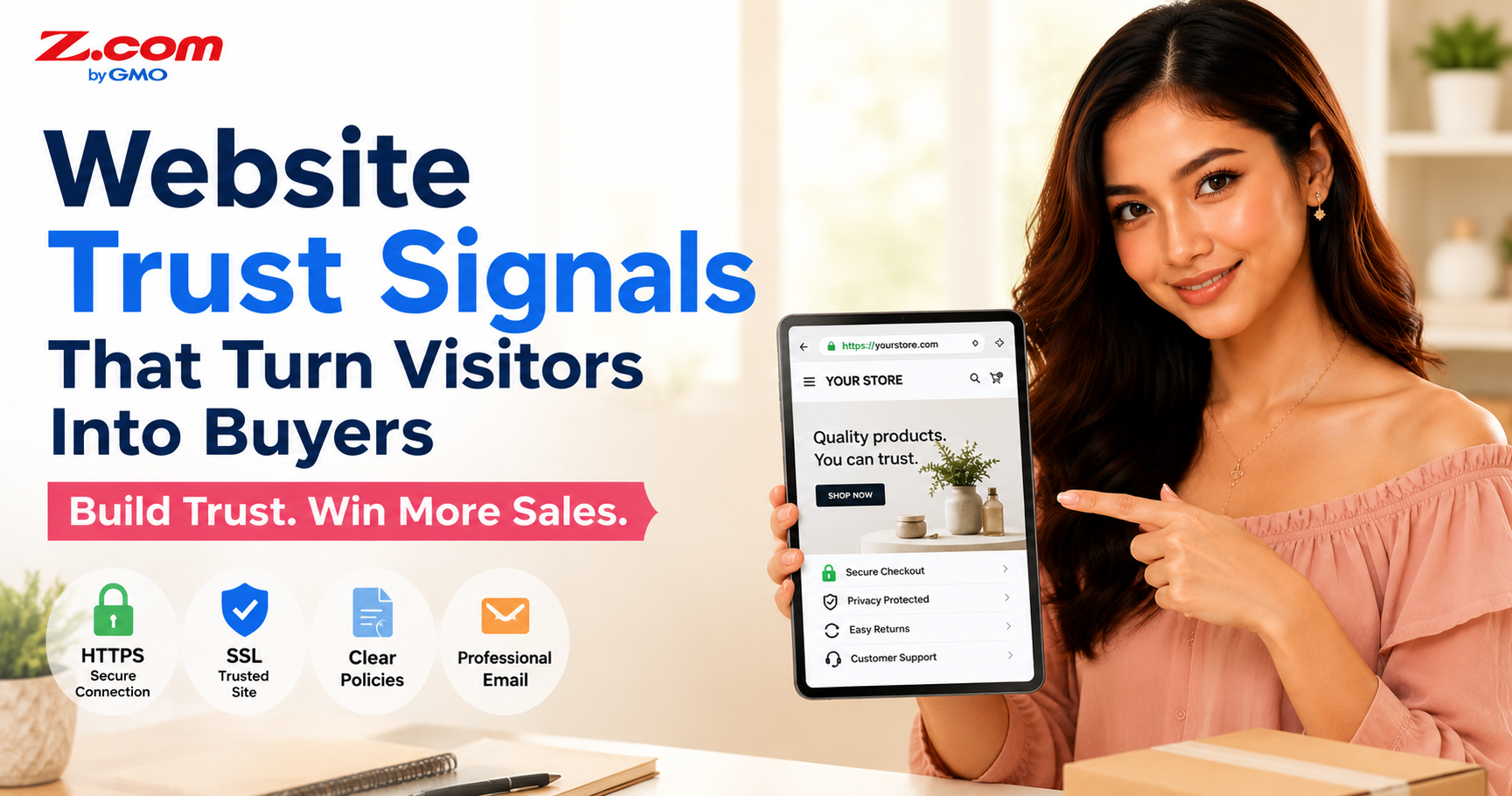
Website Trust Signals That Turn Visitors Into Buyers
In This Article:
- ✓ Distrust makes shoppers abandon checkout pages
- ✓ A quick self-check reveals your trust gaps
- ✓ Practical signals build lasting customer confidence
Many small business owners in the Philippines have already built something valuable: trust. It may come from a loyal Facebook following, repeat buyers, positive reviews, or hundreds of Messenger conversations.
But that trust does not always transfer automatically when a customer visits your website for the first time. Without a previous experience to rely on, new visitors look for quick signs that the website, and the business behind it, is legitimate and safe to buy from.
The good news is that website trust can be strengthened with practical changes. This article explains why first-time visitors hesitate, how to identify trust gaps on your website, and which trust signals can help online sellers and growing businesses turn more visitors into confident customers.
Table of contents
Understanding Customer Hesitation Online
Every online buyer runs a fast, mostly unconscious trust check before completing a purchase. In a large-scale survey of online shoppers, Baymard Institute found that 19% cited not trusting a site with their credit card information as a reason for abandoning their cart, placing payment trust among the leading causes of checkout abandonment alongside unexpected costs and lengthy checkout steps. For small and growing businesses, this matters even more, because visitors often have no prior relationship with the brand to fall back on.
This does not mean your product or service is the problem. A shopper who found you through a Facebook group, a Messenger inquiry, or a friend's recommendation already believes you can solve their problem. What they are actually evaluating is whether this specific website, on this specific day, is safe enough to hand over their details to. Strengthening a few visible signals can move a curious visitor from hesitant to confident, and the checks that matter most are usually the ones a business owner overlooks simply because they see their own website every day.
It also helps to remember that hesitation shows up differently depending on what you are selling. A shopper buying a low-cost item may only glance at the page before deciding, while someone about to pay for a service, a bulk order, or a higher-priced product will look more closely for reassurance. Knowing which trust signals matter most for your type of business helps you prioritize improvements instead of trying to fix everything at once.
Quick Trust Signal Self-Check
Before making changes, take five minutes to view your website the way a first-time visitor would. Open your site in a private browser window and check for the following:
- Does your website use HTTPS without showing a security warning in the browser?
- Can visitors quickly find a phone number, email address, or physical location?
- Does your business email use your own domain instead of a free webmail address?
- Are your shipping, return, or service policies visible before checkout?
- Do product pages include real photos, reviews, or customer messages?
If you answered "no" to two or more items, you likely have a trust gap worth closing. The sections below cover the highest-impact fixes, starting with the most fundamental one: how your website handles security itself.
Securing Your Checkout With HTTPS
HTTPS is the encrypted version of the connection between a visitor's browser and your website, made possible by installing an SSL certificate on your server. Since 2018, Chrome and other major browsers have marked pages without HTTPS as "Not secure," a label that appears in the address bar before a visitor reads a single word of your content. Google has also confirmed HTTPS as a ranking signal, so encryption supports both trust and visibility at the same time. Setting this up is usually a one-time task handled through your hosting provider, which makes it one of the most efficient trust-building steps available to a growing business.
What HTTPS Tells Customers
A secure HTTPS connection confirms that data sent between the browser and your server is encrypted, so passwords, addresses, and card details cannot be easily intercepted in transit. It does not automatically confirm who owns or operates the website, which is a separate layer of assurance that certificate validation levels are designed to address.
Understanding SSL Validation Levels
SSL certificates are available at three common validation levels. A Domain Validated (DV) certificate confirms control of the domain and provides HTTPS encryption, making it a practical choice for blogs, portfolios, and many general websites. An Organization Validated (OV) certificate also verifies the organization behind the website, making it suitable for businesses that want to provide additional identity assurance. An Extended Validation (EV) certificate involves the most rigorous business verification process and is designed for organizations that want the highest level of verified identity assurance. The right level depends on how much identity verification your business wants to demonstrate, not on encryption strength or how often a site processes payments.
| Certificate | What It Verifies | Key Benefit |
|---|---|---|
| DV | Domain control | Fast, straightforward validation |
| OV | Domain control and organization identity | Verified business identity |
| EV | Domain control and extensive organization details | Highest level of identity assurance |
Trust Signals Beyond HTTPS
HTTPS encryption is the foundation, but customers look for more than a secure connection before trusting a new website. These signals are easier to build than most business owners expect, and several of them can be improved within a single afternoon.
Professional Domain and Business Email
A website address that matches your business name, paired with an email address on your own domain rather than a free @gmail.com or @yahoo.com account, signals that a business is established and intends to stay online. This kind of professional address, such as one set up through Titan Email, can help customers more easily recognize communications as coming from your business.
Clear Policies and Contact Details
Visible shipping timelines, return policies, and at least one direct contact method reduce the uncertainty that stops many first-time buyers from checking out. This is especially useful for home-based businesses and solo entrepreneurs who do not yet have a large public track record.
These details do not need a dedicated page to be effective. A short line near the checkout button, such as expected delivery time or how refunds are handled, often does more for confidence than a lengthy terms-of-service page that most visitors will never open. The goal is to answer the questions a hesitant buyer is already asking themselves before they reach for their wallet.
Trust Building for Social Sellers
Many Filipino entrepreneurs start selling through Facebook groups or Messenger before launching a dedicated website. That history is valuable, but it lives on someone else's platform. Bringing customers to your own web hosting setup, backed by visible security signals, protects that relationship regardless of platform changes.
For sellers who already accept GCash payments or take orders through Messenger, a secured website adds a second, independent layer of confidence, particularly for larger orders or first-time customers who have not yet built a relationship with the seller. It also helps smaller businesses appear on equal footing next to larger, established brands competing for the same shoppers.
This matters most at the exact moment a customer decides whether to keep chatting on Messenger or move to a full checkout page. A seller who already replies quickly and clearly to inquiries, and pairs that responsiveness with a secured website, gives cautious buyers one less reason to abandon the purchase partway through. Over time, these small consistent signals become part of a business's reputation, alongside the reviews and recommendations that already bring customers in.
Do small business websites really need an SSL certificate?
Yes. Any website that collects information through contact forms, accounts, or checkout pages benefits from encryption, and modern browsers flag unencrypted pages as "Not secure." Even simple informational sites benefit from the search ranking signal that HTTPS provides, making it a practical baseline for any business website today.
What is the difference between DV, OV, and EV SSL certificates?
All three provide the same HTTPS encryption. The difference is how thoroughly the certificate authority verifies the organization behind the website: DV confirms domain control only, OV also verifies the registered business, and EV involves the most rigorous verification process. Businesses choose OV or EV when they want a stronger, independently verified identity, not because encryption differs between levels.
Is a free SSL certificate enough for an online store?
A free Domain Validated (DV) SSL certificate can provide the HTTPS encryption that most websites need. Businesses that want their organization identity to be independently verified may consider an OV or EV certificate. The right choice depends on the level of identity validation your business requires, rather than on encryption alone.
Does HTTPS actually affect search rankings?
Google has confirmed HTTPS as a lightweight ranking signal, and it factors into broader trust and safety evaluations alongside site speed and content quality. While it is not the only ranking factor, moving from HTTP to HTTPS removes a barrier that could otherwise limit visibility or trigger browser warnings.
Building customer trust online rarely comes down to one single change. It comes from stacking several small, visible signals, encryption, a professional domain and email, clear policies, and honest contact information, until a first-time visitor feels confident enough to buy. Filipino entrepreneurs already have real relationships with their customers through Facebook groups, Messenger conversations, and word of mouth. Bringing that same confidence to a dedicated website closes the gap between "I know this seller" and "I trust this website." Start with the self-check earlier in this article, address the gaps that matter most for your business, and treat trust-building as an ongoing part of growing your online presence.
Protect your website with HTTPS and choose the level of identity validation that fits your business.
Compare DV, OV, and EV SSL certificate options to find the right level of validation for your website.
View SSL Certificate Plans