

How a Professional Email Address Supports Business Credibility in the Philippines
Imagine receiving a payment request for ₱85,000 worth of merchandise from a supplier whose email ends in @gmail.com. Would you wire the money? Many buyers pause — not necessarily because the seller is dishonest, but because a free email address is one of the early signals some buyers use to judge how established a business is.
For Philippine SMBs, freelancers, and online sellers, a professional email address is one of the simplest and most affordable credibility signals available. Yet many businesses still use Gmail or Yahoo for all client and supplier communication, and may miss opportunities without ever learning why. Gmail itself is a capable email interface; the issue discussed here is the free @gmail.com address, not the tool.
Executive Summary
Using a free email address like @gmail.com for business communication can create a credibility gap with some buyers and suppliers. A domain-matched email address (you@yourbusiness.com) presents a consistent brand identity on a domain you control. It does not prove business registration or guarantee deliverability or sales. Professional email hosting in the Philippines starts at ₱98 per month and includes unlimited accounts on your own domain, sharing the plan's storage.
Quick Answer
Often, yes — your sender email address can affect how some buyers and suppliers see your business before any conversation begins. A domain-matched address (you@yourbusiness.com) shows a consistent brand and a domain you control, but it does not prove registration or guarantee results. Professional email hosting in the Philippines starts at ₱98 per month with unlimited accounts sharing plan storage, and a free domain on eligible plans.
Table of contents
- What Buyers May Notice When You Email Them
- Four Situations Where a Free Email Address May Hurt
- Why Free Email May Read as a Risk Signal — Even When the Seller Is Legitimate
- What a Professional Business Email Address Looks Like
- How to Get a Professional Business Email Address in the Philippines
- Frequently Asked Questions
What Buyers May Notice When You Email Them
When a potential customer or supplier receives your message, the sender address appears before the subject line, before the email body, and — on mobile — sometimes before anything else. A @gmail.com or @yahoo.com address may suggest three things to some buyers:
- No dedicated business domain appears to be in use
- Business email infrastructure may not be in place
- The business may not yet have invested in its own digital identity
For informal personal transactions, this may be fine. But once you are sending proposals, quotations, invoices, or order confirmations — especially at amounts that require any consideration — the sender address becomes part of your credibility profile.
Philippine buyers who regularly source from suppliers across direct wholesale channels and platforms have become more cautious about payment fraud and unverified sellers. A professional email address does not eliminate that caution, but it may remove one of the early flags that triggers it.
Four Situations Where a Free Email Address May Hurt
1. Supplier and wholesale inquiries
Established local distributors and brand principals receive large volumes of reseller inquiries. When filtering potential partners, a company email address (@yourbusiness.com) can signal a structured operation. A Gmail address may be treated as less established by some partners — especially when the inquiry involves credit terms, bulk pricing, or a product allocation request.
2. Client proposals and service quotations
Service providers — consultants, agencies, contractors, logistics and delivery providers — routinely send proposals by email. The same proposal document reads differently depending on whether it arrives from a branded domain or a personal Gmail account. When you are competing against other providers who do have professional email, a free address may be a visible disadvantage for some buyers before the content is even opened.
3. Invoices and payment requests
Fake invoice email scams targeting Philippine businesses are a recognized threat, so careful buyers check sender details before approving payments. A domain-matched address such as you@yourcompany.com is not proof of a business registration or of who is asking to be paid — and a free address does not by itself mean an invoice is fake. Buyers should confirm any new or changed bank details through a separate, already-known contact, such as a phone number from a previous transaction.
4. Business identity and brand consistency
When your storefront, receipts, and packaging show one brand name but your contact address is a free @gmail.com address, some buyers notice the inconsistency — particularly in B2B settings or when a business is positioning itself for corporate accounts. A domain-matched address helps keep your brand name, website, and contact details consistent. It supports your brand presentation; it does not replace or prove any registration.
Why Free Email May Read as a Risk Signal — Even When the Seller Is Legitimate
This is not a claim that Gmail users are untrustworthy. Many established Filipino business owners still use free email daily. The issue is what a free address may signal before any relationship or track record is established.
A domain-matched email address carries implicit information that a free address does not:
- A domain name is in use — the address can match your brand name and a domain you control
- The business controls its own communication channel, separate from a free consumer platform
- The sender address is consistent with the business name on receipts, packaging, and any website
- The business has its own basic email setup
None of this guarantees a reliable supplier or honest seller. But it can remove one friction point in the buyer's early evaluation — and in competitive situations, reducing that friction may help earn a reply.
What a Professional Business Email Address Looks Like
A professional business email matches your registered domain. The difference is visible to anyone who reads your message:
| Use | Free Email | Professional Email |
|---|---|---|
| General inquiries | mybakeshop2026@gmail.com | hello@mybakeshop.com |
| Orders | orders.mybakeshop@gmail.com | orders@mybakeshop.com |
| Owner contact | juan.reyes.ph@yahoo.com | juan@mybakeshop.com |
| Customer support | mybakeshopsupport@gmail.com | support@mybakeshop.com |
With professional email hosting, you create as many addresses as your operation needs — general, orders, support, accounting, individual staff — without paying extra per mailbox, within the plan's shared storage. All addresses share the same domain and are managed from a single hosting account.
How to Get a Professional Business Email Address in the Philippines
The setup involves three steps: register a domain, connect it to an email hosting plan, and create your mailboxes.
Step 1: Register your domain. Your professional email will be @yourdomain.com, .com.ph, .ph, or another extension. If you already have a business website, you can use the same domain for email. If not, a .com domain can start at ₱298 for the first-year registration; the current renewal price is ₱888 per year. Choosing a domain that matches your business or trade name makes the address easier to remember and more consistent with your branding.
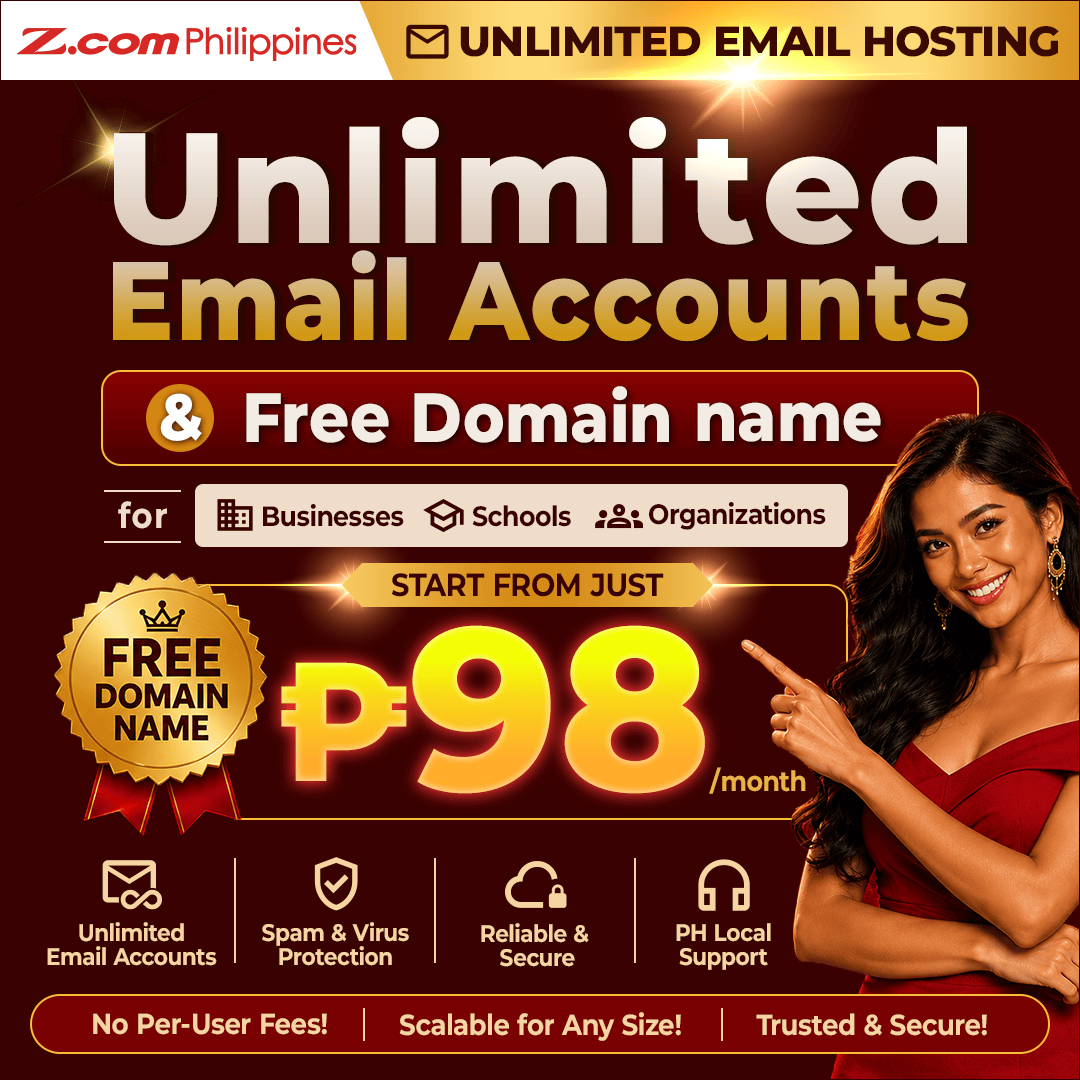
Step 2: Sign up for email hosting. Unlike per-seat plans that multiply in cost with every staff member added, storage-based email hosting charges a flat monthly fee for a shared storage pool with unlimited accounts. Z.com Unlimited Email Hosting starts at ₱98 per month for 3GB of shared storage, with no limit on the number of mailboxes you create. Unlimited refers to the number of accounts, not storage: all mailboxes draw from the same shared storage, so busy teams may eventually need a larger plan. A free domain name is included on eligible plans. You can add role-based addresses and individual staff addresses without any additional per-user charge as your team grows.
Step 3: Create mailboxes and configure access. Most email hosting plans include webmail access from any browser. For desktop or mobile email clients, standard IMAP and SMTP settings apply. Setting up SPF and DKIM authentication records through your hosting control panel is an important step, especially when your email domain is new. A custom domain alone does not improve deliverability or guarantee inbox placement; results depend on authentication and sender reputation. After setup, send test messages both ways — to and from Gmail and Yahoo accounts — and check whether they arrive in the inbox or the spam folder.
How long the transition takes varies. Domain registration, hosting setup, DNS propagation, and existing-mail migration are separate stages with different timelines. To keep receiving mail sent to an old Gmail address, set up forwarding in that Gmail account: add your new address as a forwarding address, approve the confirmation request sent to it, then enable forwarding. This is separate from forwarders on your new hosting, which only redirect mail sent to your new domain. For Yahoo, check Yahoo's help pages for supported forwarding options.
Key Takeaways
- A @gmail.com or @yahoo.com sender address may signal to some buyers that a business is less established — even when the business is legitimate.
- The gap may be most noticeable in wholesale inquiries, service proposals, payment requests, and first-contact situations with no prior relationship.
- A domain-matched email address (you@yourbusiness.com) is a low-cost way for a Philippine SMB to present a consistent brand — hosting from ₱98 per month.
- Storage-based email hosting offers unlimited accounts on your domain with no per-user fees, but all accounts share limited storage, so fit depends on your storage needs.
- Setup time varies: configuration, DNS propagation, and existing-mail migration are separate stages.
Frequently Asked Questions
Can I keep using Gmail and just add my custom domain to it?
Google Workspace lets you use a custom domain with the Gmail interface. It is priced per user and also includes collaboration tools such as shared documents and meetings, so it is not a like-for-like comparison with email-only hosting. Storage-based plans like Z.com Unlimited Email Hosting offer custom-domain email for a flat monthly fee with unlimited mailboxes sharing plan storage, which may suit teams that mainly need mailboxes or role-based addresses. Both options give you a professional email address; the difference is included features and how cost scales.
Will my existing Gmail contacts lose track of me if I switch?
Not if you plan the transition — you update your signature and contact information going forward and send a brief notice to regular clients informing them of your new address. Forwarding from your old Gmail is set up inside that Gmail account, with a confirmation step (see Step 3). Your old Gmail account continues to exist; you simply stop using it as your primary business identity.
What happens if my domain registration expires?
If your domain lapses and is not renewed, your professional email addresses stop functioning. Keep your domain renewal date noted and enable auto-renew through your registrar where available. Some email hosting plans include a free domain for the first year — review the renewal terms before sign-up to make sure continuity is not disrupted after the first year.
How many email addresses does a small business actually need?
At minimum, one general contact address (hello@ or info@) and one address per key person who communicates with customers or suppliers externally. Role-based addresses — orders@, billing@, support@ — are useful even if one person manages all of them at the start, because they set up a structure that scales. With unlimited-account email hosting, you can add addresses as your team grows without per-user fees.
Start with a Professional Business Email Address
Z.com Unlimited Email Hosting includes unlimited accounts sharing plan storage, free domain on eligible plans, and built-in spam and virus protection — starting at ₱98 per month. No per-user fees.
View Email Hosting Plans